Philippine authorities are moving to tighten legal and law-enforcement tools against a fast-evolving form of online radicalization they say is targeting children and teenagers, following the deadly June 22 school shooting in Tacloban City. The Philippine National Police (PNP) has sought assistance from foreign counterparts to trace an online extremist group known as “764,” which investigators believe may have influenced two minor suspects in the attack at San Jose National High School. PNP Chief Gen. Jose Melencio Nartatez Jr. said the force will work with law-enforcement agencies abroad to determine the group’s footprint and identify individuals behind it, as well as assess potential involvement of Filipinos and possible target victims.
The Tacloban shooting, which left three students dead, has sharpened focus in Manila on what officials and lawmakers describe as nihilistic violent extremism, or NVE. During a Senate inquiry into the incident, Senator Risa Hontiveros, who heads the chamber’s committee on women and children, said there were indications the campus attack could be linked to an “online nihilistic violent extremist” network infiltrating popular gaming platforms to brainwash vulnerable children. Senate President Sherwin Gatchalian cited what he described as a rise in reported cases of minor-inflicted violence and called for a dedicated law to counter NVE, including online grooming and the progressive “brainwashing” of youths into committing violent acts.
Justice Undersecretary Nicholas Felix Ty has outlined how NVE operates, describing it as a form of violent extremism in which children and young adults are manipulated—often on social media and gaming sites—into a sequence of increasingly serious offenses. According to Ty, behavior may start with relatively minor violations such as trespassing or vandalism before escalating into self-harm, animal cruelty and, in some instances, mass-casualty attacks. He said perpetrators exploit emotional vulnerabilities and the desire for acceptance, using those pressures to steer young people toward harmful conduct. In a previous case cited by Gatchalian, a gaming platform was linked to a planned school attack in Laguna in early 2026.
To confront these trends, the Department of Justice is advocating a comprehensive statute modeled on the Philippines’ existing anti-terrorism and anti-human trafficking laws. Ty said the DOJ is ready to work with Congress on a measure that would provide clearer legal bases to prosecute online grooming and exploitation tied to violent acts, while mobilizing a whole-of-government response involving law enforcement, education, and social welfare agencies. Pending such legislation, the department plans to recommend that the Anti-Terrorism Council adapt current counterterrorism mechanisms to address NVE, noting that similar approaches are being used in other countries. The council’s interagency structure, which already brings together the DOJ, Education and Social Welfare departments among others, offers a template that authorities say can be leveraged to strengthen intelligence gathering and coordination as lawmakers deliberate on a dedicated NVE law.
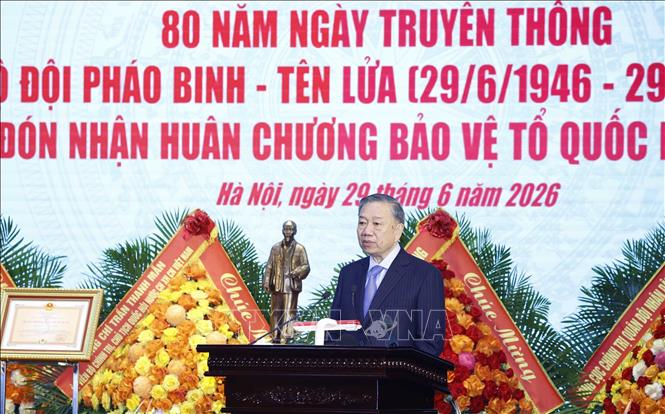
Lễ kỷ niệm 80 năm Ngày truyền thống Bộ đội Pháo binh - Tên lửa (29/6/1946 - 29/6/2026) và đón nhận Huân chương Bảo vệ Tổ quốc hạng Nhất được Bộ Tư lệnh Pháo binh - Tên lửa tổ chức trọng thể tại Hà Nội ngày 29/6. Tổng Bí thư, Chủ tịch nước Tô Lâm, với cương vị Bí thư Quân ủy Trung ương, dự và phát biểu chỉ đạo. Sự kiện có sự hiện diện của nhiều Ủy viên Bộ Chính trị, lãnh đạo các cơ quan Đảng, Nhà nước, Quân ủy Trung ương và Bộ Quốc phòng, cho thấy vị trí ngày càng quan trọng của lực lượng Pháo binh - Tên lửa trong chiến lược quốc phòng.
Theo Thiếu tướng Nguyễn Hồng Phong, Tư lệnh Bộ Tư lệnh Pháo binh - Tên lửa, lực lượng này khởi đầu từ Đoàn Pháo binh Thủ đô được thành lập ngày 29/6/1946 tại trụ sở Vệ quốc Đoàn Trung ương, số 40 Hàng Bài (Hà Nội), gồm ba trung đội Pháo đài Láng, Xuân Tảo và Xuân Canh. Từ nền tảng ban đầu đó, qua 80 năm xây dựng, chiến đấu và trưởng thành, Pháo binh đã trở thành lực lượng hỏa lực quan trọng, lập nhiều chiến công trong sự nghiệp giải phóng dân tộc và bảo vệ Tổ quốc, gắn với truyền thống “chân đồng vai sắt, đánh giỏi, bắn trúng”.
Phát biểu tại buổi lễ, Tổng Bí thư, Chủ tịch nước Tô Lâm đánh giá việc thành lập Bộ Tư lệnh Pháo binh - Tên lửa trên cơ sở Binh chủng Pháo binh vào tháng 8/2025 là một dấu mốc quan trọng, phản ánh tầm nhìn mới trong xây dựng sức mạnh Quân đội nhân dân Việt Nam. Ông yêu cầu lực lượng này “trở thành trụ cột của sức mạnh tác chiến”, tiếp tục hoàn thiện tổ chức, nâng cao năng lực tham mưu chiến lược và xây dựng thế trận pháo binh - tên lửa vững chắc trong nền quốc phòng toàn dân. Lãnh đạo Đảng, Nhà nước nhấn mạnh hiện đại hóa không chỉ dừng ở việc trang bị vũ khí mới, mà phải đồng bộ từ con người, tổ chức, chỉ huy, huấn luyện đến bảo đảm hậu cần – kỹ thuật và phương thức tác chiến.
Tổng Bí thư, Chủ tịch nước đồng thời yêu cầu Bộ Tư lệnh Pháo binh - Tên lửa chủ động xây dựng phương thức bảo đảm hậu cần – kỹ thuật phù hợp, quản lý, khai thác vũ khí trang bị “tốt, bền, an toàn, tiết kiệm”, tuyệt đối không để xảy ra mất an toàn về người, vũ khí, kho tàng, thông tin, dữ liệu và bí mật quân sự. Ông đề nghị Quân ủy Trung ương, Bộ Quốc phòng cùng các viện nghiên cứu, doanh nghiệp quốc phòng phối hợp, tạo điều kiện để lực lượng từng bước làm chủ công tác bảo dưỡng, sửa chữa, cải tiến vũ khí, đạn dược, mô phỏng, phần mềm và các công nghệ then chốt, đáp ứng yêu cầu xây dựng quân đội hiện đại. Trong bối cảnh mới, truyền thống 80 năm được kỳ vọng sẽ là nền tảng để Bộ đội Pháo binh - Tên lửa tiếp tục phát huy vai trò, đáp ứng yêu cầu bảo vệ vững chắc Tổ quốc.